
Posts Tagged ‘Victoria housing market trends’

Understanding how inventory levels affect your buying power is essential when purchasing a home in Greater Victoria. Inventory refers to the number of properties available for sale at any given time. When inventory shifts, buyer leverage, pricing trends, and competition levels often shift with it. Learning how these market changes influence negotiating strength helps buyers make more strategic decisions. What Inventory Levels Mean in Real Estate Inventory levels measure supply relative to buyer demand. When listings increase, buyers typically gain more choice and flexibility. When listings decrease, competition often rises and sellers gain more control. Recognizing how inventory levels affect your buying power allows buyers to time their purchase and adjust expectations accordingly. Higher Inventory Usually Strengthens Buyer Leverage When inventory rises, buyers often benefit from increased negotiating power. More available listings reduce urgency and allow buyers to compare homes carefully. Sellers may become more open to price adjustments, condition negotiations, or flexible closing dates. Higher inventory can also reduce the likelihood of multiple offer situations, helping buyers maintain stronger financial and emotional control. Lower Inventory Often Creates Competitive Pressure Limited inventory typically leads to higher competition. Buyers may face multiple offer scenarios, faster decision timelines, and fewer negotiation opportunities. In tighter markets, well priced homes often attract strong interest quickly. Buyers may need to act decisively and ensure financing, inspections, and deposit readiness to remain competitive. Balanced Markets Provide Strategic Opportunities Greater Victoria occasionally experiences balanced market conditions where supply and demand remain relatively aligned. In these environments, buyers benefit from stable pricing and reasonable selection while sellers still attract qualified interest. Balanced markets often allow buyers to perform due diligence without rushing while maintaining confidence in long term value stability. Inventory Impacts Pricing Trends Inventory levels influence pricing behaviour over time. Rising supply can slow price growth and create more stable values. Declining supply can increase upward price pressure as buyers compete for limited options. While price movement depends on multiple economic factors, inventory remains one of the most direct indicators of market momentum. Property Type Inventory Matters Too Inventory changes do not affect every property segment equally. Condominiums, townhomes, and single family homes often experience different supply cycles. For example, higher condo inventory may create entry level opportunities, while limited single family supply can maintain strong demand for detached homes. Buyers who remain flexible across property types often improve their overall purchasing options. Seasonal Inventory Patterns Influence Timing Real estate inventory often increases during spring and early summer when more sellers list their homes. Winter months typically show lower supply and reduced activity. Buyers who understand seasonal patterns can prepare financing and search criteria ahead of peak listing periods to gain an advantage when new inventory enters the market. Financing and Confidence Move With Inventory Higher inventory can improve buyer confidence by reducing pressure to waive conditions or stretch budgets. Buyers often feel more comfortable negotiating when they know alternative options exist. Lower inventory can create urgency, which sometimes leads buyers to make faster or more aggressive purchasing decisions. Making Smart Decisions in Changing Markets Monitoring inventory trends helps buyers align strategy with current market conditions. Working with local real estate professionals provides insight into micro market supply levels, neighbourhood specific trends, and property type availability. While past performance does not dictate future results, understanding supply patterns helps buyers navigate market changes with greater clarity. If you are considering purchasing a home in Greater Victoria, contact our team to review current inventory trends and develop a strategy tailored to your home search goals. Andy M., 5-Star Review, via Google “Thank you so much to Faber group for their amazing customer service. Cal and Scott were there for us every step of the way and we couldn’t be more pleased with our sale and purchase.” Faber Real Estate Group Royal LePage Coast Capital Realty 📞 250-244-3430 📧[email protected] ℹ️ Scott Faber Personal Real Estate Corporation ℹ️ Cal Faber Personal Real Estate Corporation Vanessa Wood, Zachary Parsons, and Sophie Taylor “Building Lasting Relationships, One Home at a Time.”
Read more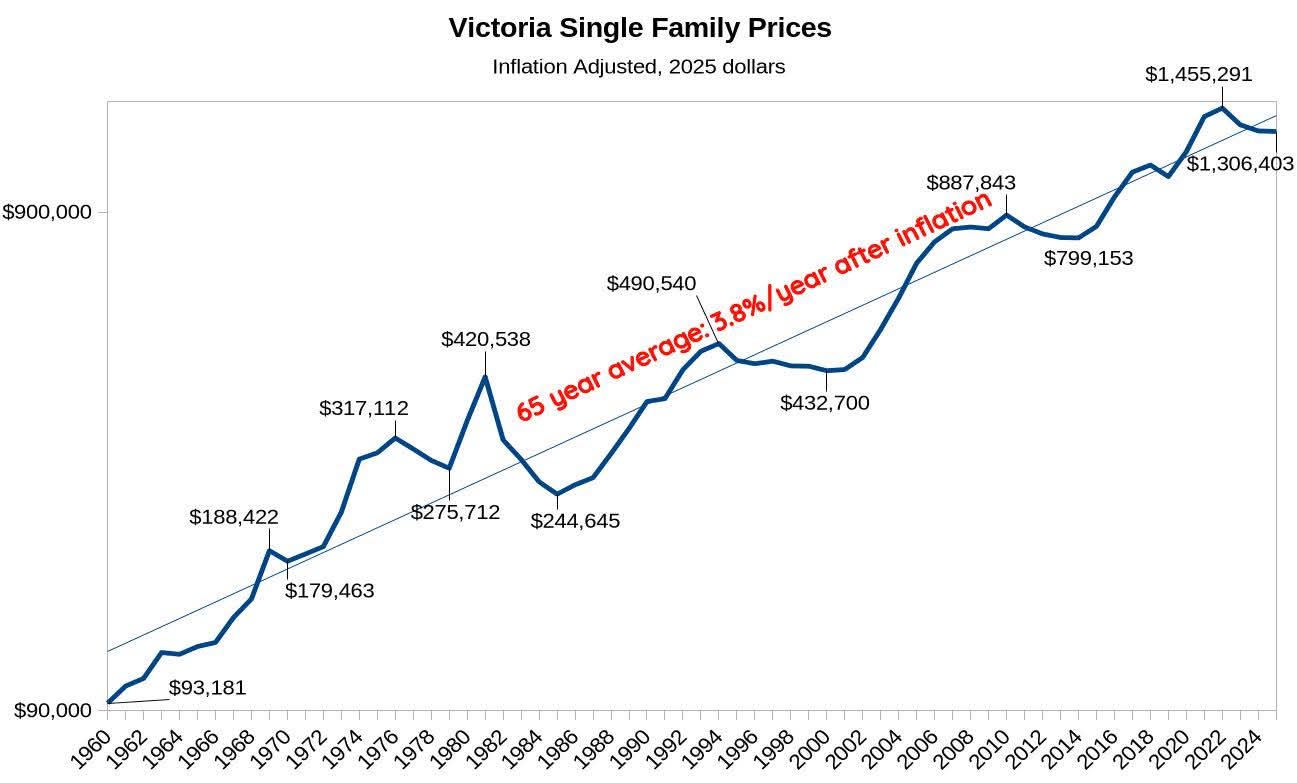
When we look at Victoria BC single-family home price inflation over the last five decades, the long-term trend shows steady growth in nominal prices that outpaces general inflation. While many narratives focus on the recent past, such as COVID, immigration, low interest rates, or specific crises, the evidence shows price inflation has been building over decades. Past performance does not dictate future results, and no single factor exclusively explains this trend. Early Growth: The 1970s and 1980s In the 1970s and early 1980s, Victoria’s housing market began a pattern of rising prices as the region’s economy grew, buoyed by stable government and service sector employment. Through the high interest rates of the early 1980s and the recession of the early 1990s, prices dipped at times but continued a long-term upward trajectory. Stabilization and Expansion: Mid-1990s to Early 2000s From the mid-1990s into the 2000s, demand increased with economic stability, limited developable land on the Peninsula, and relatively modest new supply. Nominal prices continued to rise gradually during this period. The 2008 global financial crisis slowed markets briefly, but there was no prolonged collapse as investors and local buyers still saw Victoria as a desirable place to live. Acceleration During the 2010s Entering the 2010s, prices accelerated markedly. Some attribute rapid price inflation solely to post-COVID dynamics or spikes in immigration. However, while these factors can influence short-term demand, the pattern of rising home values predates them by decades. Low interest rates after the 2008 crisis, provincial and national tax policies, and persistent supply constraints played roles, but none in isolation fully explain the long-term Victoria BC single family home price inflation. The COVID-19 Market Surge During and after the COVID-19 pandemic, many markets, including Victoria’s, saw sharper short-term increases. Still, this represents an amplification of pre-existing trends, not the beginning of them. Factors such as remote work and changing lifestyle preferences likely contributed to near-term demand swings, but research consistently shows that long-term price trends are influenced by multiple factors rather than a single event or policy. Multiple Forces Driving Long-Term Price Growth In reviewing 50 years of data, it is clear that demographics, economics, land supply, local planning policy, and broader macroeconomic conditions all interact. Narratives that claim the market rapidly escalated only after one event, such as COVID, high immigration, low rates, or a past financial crisis, are not fully supported by the evidence. These events influence the market, but long-term price inflation has been ongoing. Understanding Long-Term Housing Market Complexity Understanding Victoria BC single family home price inflation requires acknowledging the complexity of housing markets. While past performance does not dictate future results, long horizons help illustrate that price trends emerge from structural and cyclical influences over time. Lou N., 5-Star Review, via Google “Scott is a knowledgeable, professional, dedicated and thorough expert in his field. Excellent at what he does and we couldn't have found a better realtor to guide us through one of the most important decisions in our lives.” Faber Real Estate Group Royal LePage Coast Capital Realty 📞 250-244-3430 📧[email protected] ℹ️ Scott Faber Personal Real Estate Corporation ℹ️ Cal Faber Personal Real Estate Corporation Vanessa Wood, Zachary Parsons, and Sophie Taylor “Building Lasting Relationships, One Home at a Time.”
Read more