
Posts Tagged ‘Victoria BC home sellers’

Selling in the Greater Victoria summer market can be a strong opportunity, but it requires the right strategy. The Greater Victoria summer market often brings motivated buyers, better curb appeal, longer days, and more flexibility for showings. However, it can also bring more competition and a slower decision cycle as buyers balance house hunting with travel, family plans, and summer schedules. For sellers, the key is not just listing because the weather is good. The key is understanding how buyers behave during this part of the year and positioning your home accordingly. Summer Buyers Can Be Motivated, But Selective Summer buyers are often serious. Many want to make a move before the fall, especially families hoping to settle before the next school year or buyers relocating for work. Longer days also make it easier for people to view homes after work and attend weekend open houses. However, today’s buyers are also more careful. With more inventory available across Greater Victoria, buyers have more options to compare. They may take longer to make decisions, revisit properties, review recent sales more closely, and pay attention to details that could affect value. This means sellers need to be realistic from the beginning. A strong first impression matters, but so does pricing, preparation, and market positioning. Pricing Needs to Match the Market One of the most important parts of selling in the summer is getting the price right. A home can show beautifully, have strong marketing, and attract plenty of online attention, but if the price feels too high compared with similar listings, buyers may wait. In a market with more choice, buyers are less likely to rush into an offer just because they like the home. Pricing should be based on: Recent comparable sales Current competing listings Property condition Location and neighbourhood demand Buyer activity in your specific price range A strong pricing strategy does not mean underpricing your home. It means entering the market at a number that feels supported, explainable, and competitive. This helps create confidence for buyers and gives your listing a better chance of building momentum early. Presentation Carries More Weight in the Summer Summer can make a home look its best. Gardens are fuller, natural light is stronger, patios feel more inviting, and outdoor spaces become a bigger part of the buyer experience. That also means expectations are higher. Before listing, sellers should focus on the details that help the home feel cared for and easy to imagine living in. Simple improvements can make a meaningful difference, especially when buyers are comparing several homes in the same price range. Focus on: Fresh landscaping and clean outdoor spaces Pressure washing patios, walkways, and siding Clean windows to maximize natural light Light seasonal staging Decluttering garages, sheds, and storage areas Highlighting patios, decks, yards, and garden areas Buyers do not need everything to be perfect, but they do need the home to feel well-maintained. In summer, outdoor spaces are part of the showing, not an afterthought. Showings May Need More Flexibility Summer schedules can be less predictable. Buyers may be away on weekends, working around travel, or trying to fit showings into evenings. Sellers who are flexible with access can have an advantage. This is especially important during the first two weeks on market. That early window is when the listing is fresh, buyer interest is highest, and online attention is strongest. If possible, make showings easy to book and avoid overly limited access. A serious buyer may only have one short window to view the property. If the home is difficult to see, they may move on to another option. The First Impression Starts Online Most buyers will see your home online before they ever step through the door. In the summer market, strong visuals are especially important because buyers are often scrolling through listings quickly and comparing multiple homes at once. Professional photography, clear descriptions, floor plans, video, and thoughtful marketing can help your home stand out. The goal is not just to show the home. The goal is to help buyers understand why it is worth viewing. Your listing should clearly communicate: The lifestyle the home offers Recent updates or improvements Outdoor space and seasonal features Neighbourhood benefits Walkability, schools, parks, transit, and nearby amenities Parking, storage, suites, strata details, or flexible spaces A good listing answers questions before buyers ask them. That can help reduce hesitation and encourage stronger showing activity. Competition Still Matters Even in a season with good buyer activity, your home does not sell in isolation. It competes against other listings nearby, similar properties in the same price range, and homes that may offer better condition, more updates, or stronger value. Before listing, sellers should look closely at what buyers will be comparing their home against. Ask: What else can a buyer purchase at this price? How does our home compare in condition? Are we priced ahead of the market, behind it, or in line with it? Does the listing clearly explain the value? What concerns might buyers notice during a showing? This type of thinking helps sellers make better decisions before going live. It can also prevent unnecessary price reductions later. Summer Timing Can Work Well With the Right Plan Summer can be a good time to sell in Greater Victoria, but timing alone is not the strategy. A successful sale depends on preparation, pricing, exposure, and how well the home meets current buyer expectations. Some homes will benefit from launching early in the season when buyer activity is strong. Others may need a little more preparation before hitting the market. In some cases, waiting a few weeks to improve presentation, complete small repairs, or build the right marketing package can create a stronger result. The best timing depends on the home, the neighbourhood, the price range, and the seller’s goals. Final Thoughts The Greater Victoria summer market can offer real opportunity for sellers, but it rewards preparation. Buyers are active, but they are also comparing carefully. They want homes that feel well-presented, properly priced, and aligned with current market value. For sellers, the best approach is simple: understand the competition, prepare the home properly, price with confidence, and make the listing easy for buyers to engage with. If you are thinking about selling this summer, start with a clear understanding of your home’s position in today’s market. The right strategy can help you attract stronger interest, reduce buyer hesitation, and move forward with more confidence. Gemma Kemp, 5-Star Review, via Google “Super professional and will go out of his way to help! Not only the best realtor but also the sweetest! We felt so taken care of every step of the way! Thank you Scott for all you do and thank you Faber Group - I highly recommend!!!!” Faber Real Estate Group Royal LePage Coast Capital Realty 📞 250-244-3430 📧 [email protected] ℹ️ Scott Faber Personal Real Estate Corporation ℹ️ Cal Faber Personal Real Estate Corporation Vanessa Wood, Zachary Parsons, and Sophie Taylor “Building Lasting Relationships, One Home at a Time.”
Read more
Drainage and moisture in Victoria homes should be part of every buyer’s due diligence. A home may look warm, updated, and well-kept during a showing, but water management tells a deeper story about how the property performs through the wet season. Victoria is known for a milder climate, but rain still matters. The City of Victoria explains that stormwater systems collect runoff from hard surfaces like roads and roofs and move it away from homes and businesses to help prevent flooding. That simple idea applies at the property level too: water needs somewhere reliable to go. (victoria.ca) Why Drainage Matters So Much Water is one of the most important things to understand before buying a home. Poor drainage can affect: Foundations Basements Crawlspaces Siding Decks and balconies Landscaping Retaining walls Driveways Interior air quality Long-term maintenance costs A home does not need to be perfect, but buyers should understand how water moves around the property. The goal is to know whether the home is managing moisture well or whether there are signs of future risk. Victoria Homes Can Have Unique Moisture Considerations Greater Victoria has a wide range of housing types and land conditions. Buyers may be comparing older character homes, hillside properties, strata complexes, rural homes, low-lying lots, newer builds, and homes with crawlspaces or basement suites. Each type can carry different drainage questions. For example: Older homes may have aging perimeter drains Homes on slopes may receive water from uphill properties Low-lying lots may hold water longer after rain Crawlspaces may show signs of dampness or poor ventilation Basement suites may be more vulnerable if drainage is weak Retaining walls may suggest grading or water-pressure issues Strata properties may rely on shared drainage systems and maintenance planning This is why two homes in the same price range can carry very different long-term risk. Start Outside the Home Good drainage usually begins outside. During a showing, buyers should look at how the land slopes, where downspouts discharge, and whether water appears to be directed away from the foundation. Practical things to look for include: Gutters that are clean and properly connected Downspouts that discharge away from the home Soil or hardscaping sloped away from the foundation Low spots where water may pool Moss or staining near exterior walls Cracks in walkways or patios Retaining walls that lean or show staining Soft or soggy areas in the yard Drain grates, catch basins, or sump systems Evidence of past drainage work A buyer does not need to diagnose the issue during the showing. They just need to notice what deserves further review. Check Basements and Crawlspaces Carefully Basements and crawlspaces often reveal moisture concerns before the main living areas do. Buyers should pay attention to: Musty smells Staining on concrete or framing Efflorescence on foundation walls Standing water Damp insulation Rust on metal components Soft subfloor areas Dehumidifiers running constantly Fresh paint that may be covering old staining Stored items lifted off the floor Some moisture signs may be minor or manageable. Others may point to larger drainage, ventilation, or foundation concerns. A home inspection is especially important when a property has a crawlspace, basement suite, below-grade living area, or signs of past water entry. Roofs, Gutters, and Downspouts Matter Drainage is not only about the ground. Roof water can create major problems if it is not managed properly. Buyers should look at: Roof age and condition Missing or damaged shingles Clogged gutters Leaking gutter joints Short downspout extensions Water dumping near the foundation Overflow marks on siding Fascia or soffit staining Moss buildup Poor roof drainage on flat or low-slope sections A functioning roof and gutter system helps move water away from the home before it becomes a foundation or interior moisture issue. Moisture Can Affect More Than Repairs Drainage and moisture problems are not just about repair bills. They can affect how a home feels and functions. Moisture may contribute to: Odours Mold concerns Poor indoor air quality Damage to finishes Rot in structural components Pest issues Insurance questions Resale hesitation Future renovation limits Even when a buyer is comfortable taking on some work, they should understand the size and urgency of the issue before removing conditions. Ask the Right Questions When drainage or moisture concerns appear, buyers should ask direct questions. Useful questions include: Have the perimeter drains been replaced or repaired? When were the gutters and roof last maintained? Has there ever been water entry? Are there receipts or records for drainage work? Is there a sump pump, and how often does it run? Has the basement or crawlspace been professionally assessed? Does water pool anywhere on the property after heavy rain? Are there known issues with neighbouring runoff? Have any insurance claims been made for water damage? Are there strata minutes discussing drainage, leaks, or building-envelope concerns? For strata properties, drainage and moisture concerns may appear in meeting minutes, engineering reports, depreciation reports, or insurance documentation. Use the Inspection Period Wisely A general home inspection can identify visible signs of moisture, but buyers may need further review if something raises concern. Depending on the property, that may include: Drainage contractor review Perimeter drain scope Roof inspection Foundation assessment Sewer or storm line inspection Building envelope review Mold or indoor air quality assessment Strata document review Engineering advice for retaining walls or slopes The right level of due diligence depends on the age, condition, and complexity of the property. Do Not Panic Over Every Moisture Sign Moisture concerns should be taken seriously, but they should not automatically end the purchase. Some issues are routine maintenance. Others are manageable with proper repairs. A clogged gutter is different from chronic basement water entry. Poor downspout placement is different from foundation movement. The key is to separate small maintenance items from larger risk. Buyers should focus on: Cause Cost Urgency Repair history Professional advice Impact on future resale Whether the issue fits their budget and comfort level Clarity matters more than fear. The Bottom Line for Buyers Drainage and moisture in Victoria homes matter because water issues can affect comfort, maintenance, insurance, resale, and long-term ownership costs. A home may look excellent on the surface, but buyers should understand how it handles rain, runoff, and seasonal moisture. Before buying, look outside, check lower levels carefully, ask about past water issues, review documents, and use the inspection period to get the right professional advice. For buyers in Greater Victoria, strong due diligence is not about finding a perfect home. It is about understanding the home clearly before making a long-term decision. For advice on buying a home in Greater Victoria and reviewing property condition before subject removal, contact Faber Real Estate Group for clear, local guidance before making your next move. Lou N., 5-Star Review, via Google “Scott is a knowledgeable, professional, dedicated and thorough expert in his field. Excellent at what he does and we couldn't have found a better realtor to guide us through one of the most important decisions in our lives.” Faber Real Estate Group Royal LePage Coast Capital Realty 📞 250-244-3430 📧 [email protected] ℹ️ Scott Faber Personal Real Estate Corporation ℹ️ Cal Faber Personal Real Estate Corporation Vanessa Wood, Zachary Parsons, and Sophie Taylor “Building Lasting Relationships, One Home at a Time.”
Read more
Active listings in Greater Victoria are an important number to watch, but they do not tell the whole story on their own. Active listings in Greater Victoria show how much choice buyers have at a specific point in time, but they do not explain how quickly homes are selling, which price ranges are moving, or how different neighbourhoods are behaving. That matters because real estate headlines often focus on one number. Inventory is up. Sales are down. Prices are steady. Buyers have more choice. Sellers have more competition. Each statement may be true, but none of them gives the full picture by itself. More Listings Do Not Always Mean a Weak Market At the end of April 2026, the Victoria Real Estate Board reported 3,710 active listings for sale on the MLS, up 13.8% from March and 8.3% from April 2025. VREB also reported 643 property sales in April 2026, almost unchanged from April 2025 and up 11.1% from March. That combination matters. More listings can mean buyers have more choice. It can also mean sellers feel more competition. However, if sales remain steady, the market may still be balanced rather than weak. This is why inventory needs context. A market with more listings and weak demand feels very different from a market with more listings and steady buyer activity. The Type of Inventory Matters Not all listings compete with each other. A downtown condo is not competing with a Saanich family home in the same way. A Langford townhome may attract a different buyer than a waterfront property in Cordova Bay. A renovated home priced well may receive strong interest, while a similar property with deferred maintenance may sit longer. Buyers and sellers need to look beyond the total inventory number and ask: What type of homes are available? Which price ranges have the most competition? How much of the inventory is well-priced? How much of it needs major updates? Are buyers active in this specific segment? Are similar homes selling, or just sitting? A higher number of listings does not automatically mean buyers have more good options. Sometimes it means they have more to sort through. Sales Activity Tells You Whether Buyers Are Responding Active listings show supply. Sales show demand. When inventory rises but sales also remain active, it often points to a more balanced market. Buyers have more time to compare, but strong properties can still sell. Sellers may need to be more careful with pricing and presentation, but they are not necessarily in a distressed position. VREB described the April 2026 Greater Victoria market as balanced, with strong inventory and a wide range of properties at different price points. VREB also noted that market experience can vary depending on location and property type because Greater Victoria is made up of many micro-markets. That last point is key. The overall market may be balanced, while one neighbourhood feels competitive and another feels slower. Price Does Not Move the Same Way Everywhere Inventory levels can influence prices, but they do not control prices on their own. In April 2026, the MLS Home Price Index benchmark value for a single-family home in the Victoria Core was $1,339,100, down 1.2% from April 2025 but up from March 2026. The condo benchmark value in the Victoria Core was $558,300, down 0.8% from April 2025 but also up from March. This shows why simple market narratives can mislead people. A buyer may hear that inventory is up and expect major discounts. A seller may hear that prices are stable and assume their home can be priced aggressively. Both can be wrong. Pricing depends on condition, location, property type, buyer demand, competing listings, and recent comparable sales. Days on Market and Price Reductions Add More Clarity Active listings tell you what is available today. They do not show the full behaviour behind the market. To understand what is really happening, buyers and sellers should also look at: Days on market Recent sale prices List-to-sale price ratios Price reductions New listings coming on Expired or cancelled listings Competing inventory by neighbourhood Showing activity Offer activity These details help explain whether listings are building because homes are overpriced, because more sellers are entering the market, or because buyers are taking longer to decide. That distinction matters. What This Means for Buyers For buyers, more active listings can create better choice and less pressure. It may also create more confusion. When there are more options, it becomes easier to compare homes but harder to decide. Buyers may hesitate, hoping something better will appear. That can be reasonable in some segments, but risky in others. A strong buyer strategy should focus on: Knowing which neighbourhoods fit your lifestyle Comparing property condition carefully Watching how long similar homes are taking to sell Understanding whether the list price reflects current market reality Staying ready when a well-priced home appears More inventory gives buyers breathing room, but it does not remove the need for preparation. What This Means for Sellers For sellers, more active listings usually means presentation and pricing matter more. When buyers have more choice, they compare more carefully. They notice condition, layout, updates, maintenance, location, and price. A listing that may have stood out in a lower-inventory market may need stronger positioning when similar homes are available. Sellers should pay close attention to: How their home compares to active competition Whether recent sales support the asking price How buyers are responding after showings Whether the first two weeks generate enough interest Which improvements may improve buyer confidence Whether the marketing clearly explains the home’s value In a balanced market, sellers can still do well. They just need to compete on value, not assumption. The Better Question Is Not Just “How Many Listings Are There?” The better question is: what do the listings mean? Active listings are useful, but they are only one part of the market story. The number becomes more meaningful when paired with sales activity, buyer demand, pricing trends, property type, condition, and neighbourhood-level competition. For buyers, the goal is not just to find more homes. It is to find the right home at the right value. For sellers, the goal is not just to list in a market with activity. It is to position the home clearly within the choices buyers already have. If you are trying to understand what today’s inventory means for your next move, contact Faber Real Estate Group for local advice, current market insight, and a strategy based on your specific neighbourhood, price range, and goals. Michael F., 5-Star Review, via Google “If you want the best in town, stop your search – you've found them here in Cal and Scott Faber. We couldn't be happier with the results and highly recommend them to anyone in need of top-notch real estate services. Professional, patient, and caring results guaranteed.” Faber Real Estate GroupRoyal LePage Coast Capital Realty📞 250-244-3430📧 [email protected]ℹ️ Scott Faber Personal Real Estate Corporationℹ️ Cal Faber Personal Real Estate CorporationVanessa Wood, Zachary Parsons, and Sophie Taylor“Building Lasting Relationships, One Home at a Time.”
Read more
Downsizing in Greater Victoria is often sold as a simple idea: sell the bigger home, buy something smaller, and enjoy less maintenance. In reality, downsizing in Greater Victoria is usually less about square footage and more about timing, emotions, and decision-making. For many homeowners, this is not just a move. It is a major life transition. You may be leaving a long-term family home, adjusting your monthly costs, changing neighbourhoods, or moving from detached living into a condo or townhouse. That is why the best downsizing plans are not rushed. They are structured. The good news is that downsizing does not have to feel overwhelming. With the right plan, it can feel lighter, clearer, and much more manageable. Start With the Reason, Not the Property A lot of people begin by browsing listings. That usually comes too early. Before you look at homes, get clear on why you want to downsize in the first place. Common reasons include: less upkeep fewer stairs lower monthly costs a simpler lifestyle being closer to family, amenities, or medical services unlocking equity for retirement or travel This step matters because “smaller” is not always the same as “better.” A move only works if it improves daily life. Define What You Still Need One of the biggest downsizing mistakes is focusing too much on what to cut and not enough on what still matters. Think about the features you use every week, not the ones that only sound good on paper. That may include: main-floor living a guest bedroom a garage or secure storage outdoor space pet-friendly rules walkability elevator access low-maintenance living room for hobbies, visiting family, or working from home Downsizing works best when it supports your next stage of life instead of forcing constant compromise. Decide Whether You Need to Sell First or Buy First This is one of the biggest strategic decisions in the entire process. Selling first can give you more clarity on budget and reduce financial pressure. Buying first can give you certainty on where you are going next, but it may add stress if your current home has not sold yet. The right answer depends on: your finances how much equity you have your comfort with carrying two properties the type of home you are trying to buy how flexible your timeline is This is where a clear step-by-step plan matters. The move itself is often less stressful than the uncertainty between the sale and the purchase. Build a Downsizing Timeline Early The homeowners who feel the most pressure are usually the ones trying to make every decision at once. A better approach is to break the move into stages. A practical downsizing timeline often looks like this: decide where you want to move and what type of home fits understand your likely sale price and net proceeds create a decluttering and sorting schedule plan any light updates or home prep before listing build a purchase strategy around your timing arrange movers, storage, and key support people well in advance This turns one large emotional project into a series of smaller, more manageable steps. Declutter Earlier Than You Think You Need To Most downsizers underestimate how long this part takes. Decluttering is not just a physical job. It is emotional. You are sorting through years, and sometimes decades, of belongings, paperwork, furniture, and family history. Start with the easiest categories first: duplicates expired items rarely used kitchenware old linens unused furniture storage areas and closets Leave sentimental items for later, once you have momentum. You do not need to make every decision in one weekend. Slow, steady progress usually works better than an all-at-once push. Measure the Financial Side Carefully Many homeowners assume downsizing automatically means spending less. That is not always true. A smaller home can still come with: strata fees property taxes moving costs legal fees renovations or furnishing changes storage expenses higher price points in certain neighbourhoods or building types That is why downsizing should be treated as a full financial strategy, not just a sale and purchase. The question is not only, “What can we sell for?” It is also, “What will the next home actually cost us to own and enjoy?” Think Beyond Price When Choosing the Next Home A lower-maintenance lifestyle sounds great until the layout does not work, the building rules are restrictive, or the location makes daily life harder. When comparing options, look at: layout efficiency storage future mobility needs parking guest access strata rules noise walkability ease of travel to appointments, shopping, and family The best downsizing move is often the one that makes life simpler every day, not just the one with the smallest floor plan. Get Help Before the Pressure Builds Downsizing tends to go much better when homeowners do not try to carry the whole process alone. That support may include: a REALTOR® family members a mover an organizer an estate sale company a lawyer or notary trusted trades for small home-prep items The earlier you build your support team, the less last-minute stress you create. Expect the Emotional Side This part often gets overlooked. Leaving a long-term home can bring relief, but it can also bring grief, doubt, and second-guessing. That is normal. Even when the move is the right one, it can still feel big. Give yourself room for that. A good downsizing plan creates space for practical decisions and emotional transitions at the same time. Final Thoughts Downsizing in Greater Victoria can be one of the smartest moves a homeowner makes, but it usually works best when it is planned with care. The goal is not just to move into a smaller property. The goal is to move into a home and lifestyle that feel easier to manage, more supportive, and better aligned with what comes next. If you are thinking about downsizing and want a clear plan before making any major decisions, contact Faber Real Estate Group for advice tailored to your timeline, budget, and next chapter. Lorraine P., 5-Star Review, via Google “I would not dream of ever using a realtor other than Cal. Apart from the fact that he is was exceptionally knowledgable and resourceful, he was also honest, truthful and always acted in my best interest while at the same time treating all parties with dignity and respect.” Faber Real Estate Group Royal LePage Coast Capital Realty 📞 250-244-3430 📧 [email protected] ℹ️ Scott Faber Personal Real Estate Corporation ℹ️ Cal Faber Personal Real Estate Corporation Vanessa Wood, Zachary Parsons, and Sophie Taylor “Building Lasting Relationships, One Home at a Time.”
Read more
The Greater Victoria real estate market is giving buyers more room to breathe than it did a year ago. The Greater Victoria real estate market is still active, but it is clearly more competitive for sellers. Sales are down from last year, inventory is up, and buyers have more time to compare options, negotiate, and look for value. In March 2026, a total of 579 properties sold through the Victoria Real Estate Board, which was 5.5% lower than March 2025, when 613 properties sold. Detached home sales were down 2.4% year over year, and condo sales were down a sharper 18.8%. At the same time, active listings climbed to 3,261, up 7.9% from March 2025 and 12.3% from February 2026. That matters because it tells us buyers are not competing in the same tight environment they were used to in past markets. What That Means in Plain Terms This is a market with more supply and softer demand than last spring. That does not mean homes are not selling. It means sellers need to adjust their expectations. When inventory rises and sales fall, buyers gain leverage. They can be more selective. They can wait for the right home. They can compare condition, location, layout, and price across more listings. They are also more likely to push for better terms, ask tougher questions, and look for homes they feel are priced well from day one. For sellers, this is not the kind of market where most properties can simply come out high and expect to attract a top-dollar result. The strategy has to be tighter than that. Price, presentation, and timing all matter more when buyers have options. Buyers Are Looking for Deals One of the clearest signals in the current numbers is that buyers are shopping carefully. The Victoria Core benchmark for a single family home in March 2026 was $1,330,200, down 1.1% from March 2025. The benchmark for a condo was $553,800, down 0.8% year over year. Prices have not collapsed, but the direction tells an important story: buyers are resisting overpricing, and values are not rising fast enough to bail out an ambitious list price. That is why today’s buyers are often drawn to homes that feel like strong value. They are not just asking, “Do I like this home?” They are also asking, “Is this priced better than the other five I saw this week?” In a market like this, the overpriced listing often becomes the listing that sits. The Market Is Close to Buyer-Friendly Territory The sales-to-active listings ratio helps explain the tone of the market. In March 2026, there were 550 total residential sales and 3,261 active listings, which works out to roughly 16.9%. VREB notes that for Victoria, a ratio below 17% points to downward pressure on prices, 17% to 28% is considered balanced, and above 28% signals upward pressure on prices. In other words, the market is sitting right on the edge of buyer-friendly conditions. That does not mean every neighbourhood or property type behaves the same way. Greater Victoria is still made up of many micro-markets. A well-priced home in a high-demand pocket can still move quickly. But broadly speaking, sellers are competing harder for attention than they were a year ago. What Sellers Need to Understand Right Now If you are thinking about selling, the message is not “do not sell.” The message is do not sell with last market’s expectations. This market rewards sellers who: price based on current competition, not peak headlines prepare the home properly before it hits the market understand what buyers will compare it against respond quickly when feedback points to price or condition concerns This is especially important because buyers are no longer being rushed into decisions at the same pace. VREB itself noted that the current mix of supply and demand has created fewer high-pressure transactions and has given both sides more time for due diligence and decision-making. That is a major shift from the kind of market where almost any decent listing could rely on urgency to do part of the work. The Bottom Line The current Greater Victoria market is more competitive for sellers than it was last year. Sales are down. Inventory is higher. Buyers have more choice and are looking closely for value. That means top-dollar outcomes are still possible, but they are far less likely to come from overpricing or wishful thinking. They come from accurate pricing, strong preparation, and a strategy built for the market that exists now, not the one sellers remember. For homeowners considering a move, this is the time to be realistic, not reactive. A smart strategy can still produce a strong result, but the market is asking sellers to earn it. If you are thinking about selling and want honest advice on where your home fits in today’s market, contact Faber Real Estate Group for a clear pricing and positioning strategy tailored to your property. Michael F., 5-Star Review, via Google “Cal and Scott exceeded our expectations in every way. They were always available to answer our questions and address any concerns immediately, providing exceptional support throughout the entire process. Their dedication and expertise made the selling and buying experience seamless and stress-free.” Faber Real Estate Group Royal LePage Coast Capital Realty 📞 250-244-3430 📧[email protected] ℹ️ Scott Faber Personal Real Estate Corporation ℹ️ Cal Faber Personal Real Estate Corporation Vanessa Wood, Zachary Parsons, and Sophie Taylor “Building Lasting Relationships, One Home at a Time.”
Read more
The spring market in Victoria, BC is now taking shape, and this year it looks more balanced, more selective, and less rushed than the fast-moving markets many people still remember. March 2026 sales in the Victoria Real Estate Board region rose to 579 properties, up 24.5 per cent from February, while active listings climbed to 3,261. VREB described this as a fairly typical spring pattern that usually builds toward May or June. More Listings Means More Choice One of the clearest themes this spring is inventory. Buyers are seeing more options than they did in many recent spring markets, and that changes the tone of the market. At the end of March 2026, active listings were up 12.3 per cent from February and 7.9 per cent from March 2025. That matters because more selection usually gives buyers more time to compare properties, review documents carefully, and make decisions with less pressure. This trend was already building in February. VREB reported 2,903 active listings at the end of that month, up 10.6 per cent from January and 10.4 per cent from the year before. In other words, spring did not suddenly appear in March. It has been building in stages, with supply steadily improving as more sellers prepare to list. Buyers Should Expect Better Conditions Than Recent Years For buyers, this spring should feel more manageable than the highly competitive conditions of past years. VREB noted that current conditions are creating fewer high-pressure transactions and allowing more time for due diligence. That does not mean every home will sit or every seller will negotiate heavily. Well-priced homes in strong locations can still move quickly. It does mean buyers have a better chance to compare options and make decisions with a plan rather than panic. That fits the broader provincial picture as well. BCREA says inventory across BC is running near its highest level in more than a decade, and it expects markets to remain broadly balanced in 2026, with price growth tempered by higher supply. Sellers Should Expect More Competition For sellers, the spring market still offers opportunity, but not in the same way it did in ultra-tight markets. More listings mean more competition. Buyers have more homes to compare, so pricing, presentation, and strategy matter more. A property that is well prepared and priced in line with today’s market can still attract strong attention. A property that is overpriced or poorly presented may sit longer than expected. This is where many sellers can get caught off guard. Spring brings more buyer activity, but it also brings more competing listings. More activity does not automatically mean more leverage for every seller. In a balanced market, the homes that stand out usually do so because the strategy behind them is stronger, not because the season alone carries them. This matches the current reality that VREB describes as offering opportunities for both buyers and sellers rather than strongly favouring one side. Prices Are Showing Stability More Than Acceleration If you are wondering whether spring 2026 will bring a sharp jump in prices, the current data suggests a steadier pattern. In the Victoria Core, the MLS HPI benchmark for a single-family home was $1,330,200 in March 2026, down 1.1 per cent from March 2025 but up from February 2026. The benchmark for a condo was $553,800, down 0.8 per cent year over year and also up month over month. That tells an important story. Prices are not showing the kind of fast upward pressure that buyers feared in past spring markets, but they are also not collapsing. Instead, we are seeing a market where values are relatively stable, with modest month-to-month improvement as spring demand builds. What This Means for Buyers If you are buying this spring, expect more choice, more time to think, and more room to be strategic. That said, do not confuse a more balanced market with an easy market. Good homes can still attract competition, especially if they are priced well and show well. The advantage for buyers this year is not unlimited negotiating power. It is the ability to be more deliberate. A smart buyer strategy this spring is to get clear on your budget, target neighbourhoods, and must-haves before the right property appears. When the right fit does come up, preparation still matters. The buyers who do best in a balanced spring market are often the ones who are patient first and decisive second. What This Means for Sellers If you are selling this spring, expect buyers to notice value gaps more quickly. They have more listings to compare, and that makes strong pricing and strong presentation more important. Spring can still be an excellent time to list, but it is no longer enough to rely on seasonal momentum alone. Sellers who are realistic from the start often put themselves in a stronger position than those who test the market too high and hope conditions will do the work for them. In this market, preparation, marketing quality, and pricing discipline are what create leverage. The Bottom Line on This Year’s Spring Market The spring market in Victoria, BC looks active, but measured. Sales are rising seasonally, inventory is improving, and the market is giving both buyers and sellers room to make better decisions. That is a healthier environment than the rushed conditions many people associate with spring real estate. It also means strategy matters more than ever. If you are planning to buy or sell this spring, the best next step is not to guess where the market is going. It is to understand how your specific property type, price point, and area fit into today’s conditions. If you want help building the right plan for this spring market, contact Faber Real Estate Group for advice tailored to your move. Leanne D, 5-Star Review, via Google “I would highly recommend the Faber Group this is the second time we have used them and have been over the top happy with their service. They are an honest group of men who all go above and beyond to make your experience perfect!” Faber Real Estate Group Royal LePage Coast Capital Realty 📞 250-244-3430 📧[email protected] ℹ️ Scott Faber Personal Real Estate Corporation ℹ️ Cal Faber Personal Real Estate Corporation Vanessa Wood, Zachary Parsons, and Sophie Taylor “Building Lasting Relationships, One Home at a Time.”
Read more
Deciding whether to sell before you buy Victoria BC is one of the biggest strategy questions homeowners face. It sounds simple on the surface, but the right answer depends on your equity, risk tolerance, financing options, and the type of market you are moving through. In Greater Victoria, that decision matters even more right now because inventory has been stronger while sales activity has been more measured, creating conditions that are closer to balanced, and in some segments near the threshold of a buyer’s market. The Victoria Real Estate Board reported 465 sales in February 2026, down 11.9 per cent from February 2025, while benchmark prices in the Victoria Core were relatively steady year-over-year, with single family homes at $1,307,400 and condos at $545,600. Why this decision matters so much Many sellers assume the only goal is to avoid being homeless or carrying two homes at once. That is part of it, but there is a bigger issue underneath: sequence creates leverage or pressure. When you sell first, you usually gain clarity. You know your sale price, your equity position, and your financing range. When you buy first, you may gain convenience, but you also take on more uncertainty if your current home does not sell as quickly or as strongly as expected. That is why this is not just a timing question. It is really a risk-management question. When selling before buying makes sense For many homeowners, selling first is the safer and more strategic move. It often makes sense when: you need the equity from your current home for the next down payment your finances do not comfortably support owning two properties at once you are moving up in price and want a firm budget before shopping your current property may take time to sell you want stronger negotiating clarity on your next purchase In a market with more choice for buyers, selling first can reduce the chance of being forced into a rushed price reduction later. VREB noted that January 2026 sat near the threshold between balanced and a buyer’s market due to stronger inventory and fewer sales, which is exactly the kind of environment where overconfidence can cost sellers leverage. The biggest advantage of selling first The biggest benefit is control. Once your home is sold firm, you are no longer guessing: how much equity you will walk away with whether your buyer will complete what mortgage amount you can comfortably carry how aggressively you need to negotiate on your next purchase That clarity often leads to better decision-making. Sellers who know their numbers tend to shop more confidently and avoid stretching just because a property feels emotionally right. When selling before buying may not make sense Selling first is not always the best option. It may not make sense when: you are in a very tight segment with limited replacement inventory you have strong finances and flexibility you are highly specific about location, school catchment, or property type you would rather secure the right home first and manage the overlap temporary housing would create too much disruption This is especially true for downsizers or buyers looking for a very specific product, such as a one-level townhome, a certain condo building, or a rare neighbourhood fit. In those cases, finding the next home can be harder than selling the current one. So while selling first reduces financial risk, it can increase lifestyle uncertainty if the replacement options are limited. When buying first can make sense Buying first can work well when the next home is harder to find than the current home is to sell. It may make sense when: you have substantial equity and strong financing you can qualify without relying fully on your current home sale the home you want is uncommon and worth locking in you have access to bridge financing or other short-term liquidity your current home is in a highly marketable price range and condition This strategy can also reduce pressure on your move. Instead of racing to line up dates, you may have time to renovate, pack gradually, and prepare your existing home properly for market. The trade-off is obvious: convenience can come with cost and risk. The role of subject to sale offers Some buyers try to split the difference by writing an offer that is conditional on the sale of their current home. In BC, this is commonly handled through a subject to sale clause. BCFSA’s clause guidance explains that a buyer can make their purchase conditional on entering into a sale contract for their existing property, or on that contract becoming unconditional by a certain date. BCFSA also notes that sellers often protect themselves by continuing to market the property and using time-clause language where appropriate. This approach can make sense, but it is not always competitive. In practical terms: it can protect the buyer from owning two homes it can help a seller buy without fully selling first it is usually less attractive to the seller on the other side it can be harder to win in a desirable or competitive segment So yes, subject to sale can be useful, but it should not be treated like a magic solution. It is simply one tool, and it works best when the property you are pursuing has less competition or has been on the market longer. Risks sellers often underestimate The real problem is not choosing one sequence or the other. The real problem is underestimating the downside of the wrong fit. If you sell first, the risks are: feeling rushed to buy settling for a home that is only “good enough” needing temporary housing or storage facing rising prices in the segment you want next If you buy first, the risks are: carrying two homes longer than expected accepting a weaker offer on your current property due to time pressure increasing debt and stress during the transition discovering your lender or budget is tighter than expected This is why generic advice rarely helps. The right strategy depends on what kind of move you are making, not just what the market is doing overall. A better way to think about the decision Instead of asking, “Should I sell first or buy first?” ask these questions: Is my current home easier to sell than my next home is to find? Do I need my sale proceeds to complete the next purchase? Could I comfortably carry overlap if my home took longer to sell? Am I moving because I want a better fit, or because I need a strict timeline? How much stress am I willing to absorb to gain flexibility? Those questions usually lead to a better answer than broad market opinions. What this often looks like in real life A move-up buyer with limited cash flexibility usually benefits from selling first. A downsizer targeting one specific building may prefer to buy first. A family relocating within the Westshore may choose whichever option creates the least disruption to school, work, and childcare. An investor or highly liquid homeowner may be able to be more opportunistic. The strategy should match the household, not just the headlines. The bottom line Selling before buying makes sense when financial clarity matters more than convenience. Buying before selling can make sense when securing the right replacement property is the harder part of the move. Neither path is automatically right. The best choice is the one that protects your downside while still giving you enough flexibility to make a smart move. If you are weighing whether to sell first or buy first in Greater Victoria, contact Faber Real Estate Group for advice tailored to your property, your price range, and the kind of move you want to make next. Helen M., 5-Star Review, via Google “Cal and Scott are the best. They made it happen and made the entire process of securing my condo smooth and stress free. They were always supportive, responsive, and clearly committed to getting the right result. I am very grateful for their hard work and would highly recommend them to anyone looking for reliable, dedicated realtors.” Faber Real Estate Group Royal LePage Coast Capital Realty 📞 250-244-3430 📧[email protected] ℹ️ Scott Faber Personal Real Estate Corporation ℹ️ Cal Faber Personal Real Estate Corporation Vanessa Wood, Zachary Parsons, and Sophie Taylor “Building Lasting Relationships, One Home at a Time.”
Read more
Every year, the spring real estate market brings a noticeable increase in activity. New listings rise, more buyers begin touring homes, and conversations about moving seem to happen everywhere at once. While homes sell throughout the year, spring has historically been the busiest season in real estate. Many buyers and sellers intentionally wait for this period because it tends to offer more opportunity, visibility, and confidence compared with other times of the year. Understanding why this seasonal pattern exists can help you decide whether waiting for spring is the right strategy or if moving earlier could give you an advantage. Why Sellers Often Wait for the Spring Real Estate Market For homeowners considering selling, the spring real estate market offers several advantages that can make the process feel more favourable. 1. More Buyers Are Actively Searching Spring is when many buyers begin their serious home search. Several factors contribute to this surge in activity: Warmer weather makes viewing homes easier and more enjoyable. Families planning a move often want to complete a purchase before the next school year. Buyers who paused their search during the winter holidays return to the market. When more buyers are looking at the same time, sellers often feel more confident listing their property. 2. Homes Tend to Show Better Spring can also make a property look more appealing. Gardens and landscaping begin to bloom. Natural light improves interior spaces. Outdoor areas such as patios and yards become more inviting. First impressions matter in real estate. When a home shows well both inside and outside, it can attract more interest and stronger offers. 3. Perception of Higher Sale Prices Many homeowners believe the spring real estate market brings stronger prices. In active years, increased buyer demand can create competitive situations. While pricing always depends on local supply and demand, spring often delivers: Higher showing activity More comparable sales for pricing guidance A perception of market momentum These factors can encourage sellers to list when they believe the market is most active. Why Buyers Also Wait for the Spring Real Estate Market Interestingly, the same factors that motivate sellers also influence buyers. 1. More Listings to Choose From Inventory typically increases in the spring. After a slower winter period, many homeowners decide to list their properties once the weather improves. For buyers, this means: More neighbourhood options More property types available Less pressure to buy the first home they see Having more selection can make the buying process feel more comfortable. 2. Easier Scheduling for Showings and Moving Weather plays a practical role in real estate decisions. Spring makes it easier to: Attend open houses Schedule property tours Move without worrying about winter conditions For families relocating or coordinating multiple schedules, this can be a significant factor. 3. Financial Planning After the New Year Many buyers spend the early part of the year reviewing finances. By spring, they may have: Completed mortgage pre-approvals Filed tax returns Saved additional down payment funds This preparation often leads to a surge in serious buyers entering the market between March and June. The Reality: Spring Is Competitive While the spring real estate market offers advantages, it also comes with increased competition. Buyers may face: Multiple-offer situations Faster decision timelines More competition for desirable homes Sellers, on the other hand, may find that more listings appear at the same time, which means their property must stand out. Market timing alone does not guarantee success. Pricing strategy, preparation, and marketing remain the most important factors. Why Some People Move Before Spring Interestingly, some of the best opportunities can occur just before the spring rush. For example: Buyers may face less competition in late winter. Sellers who list early can capture motivated buyers who are already searching. Serious buyers often start their search months before the peak season. In markets like Greater Victoria, conditions can shift quickly depending on inventory levels and interest rates. Recent data from the Victoria Real Estate Board shows that inventory and buyer activity fluctuate throughout the year, meaning opportunities exist in every season. This is why strategic timing, rather than simply waiting for spring, often leads to the best results. The Takeaway The spring real estate market remains the most active time of year because it brings together motivated buyers, increased listings, and favourable weather conditions. These factors create a sense of momentum that encourages many people to make their move. However, waiting for spring is not always the best strategy. In some cases, entering the market earlier can mean less competition and stronger negotiating power. If you are considering buying or selling in Greater Victoria and want to understand how seasonal timing could affect your plans, reach out to Faber Real Estate Group for guidance tailored to your goals and the current market. David M., 5-Star Review, via Google “Scott was a fantastic realtor—hardworking, knowledgeable, and truly dedicated to his clients. His expertise and great connections made the entire process smooth and stress-free. He went above and beyond to ensure everything was taken care of, and I couldn’t be happier with the results. I highly recommend Scott to anyone looking for a realtor.” Faber Real Estate Group Royal LePage Coast Capital Realty 📞 250-244-3430 📧[email protected] ℹ️ Scott Faber Personal Real Estate Corporation ℹ️ Cal Faber Personal Real Estate Corporation Vanessa Wood, Zachary Parsons, and Sophie Taylor “Building Lasting Relationships, One Home at a Time.”
Read more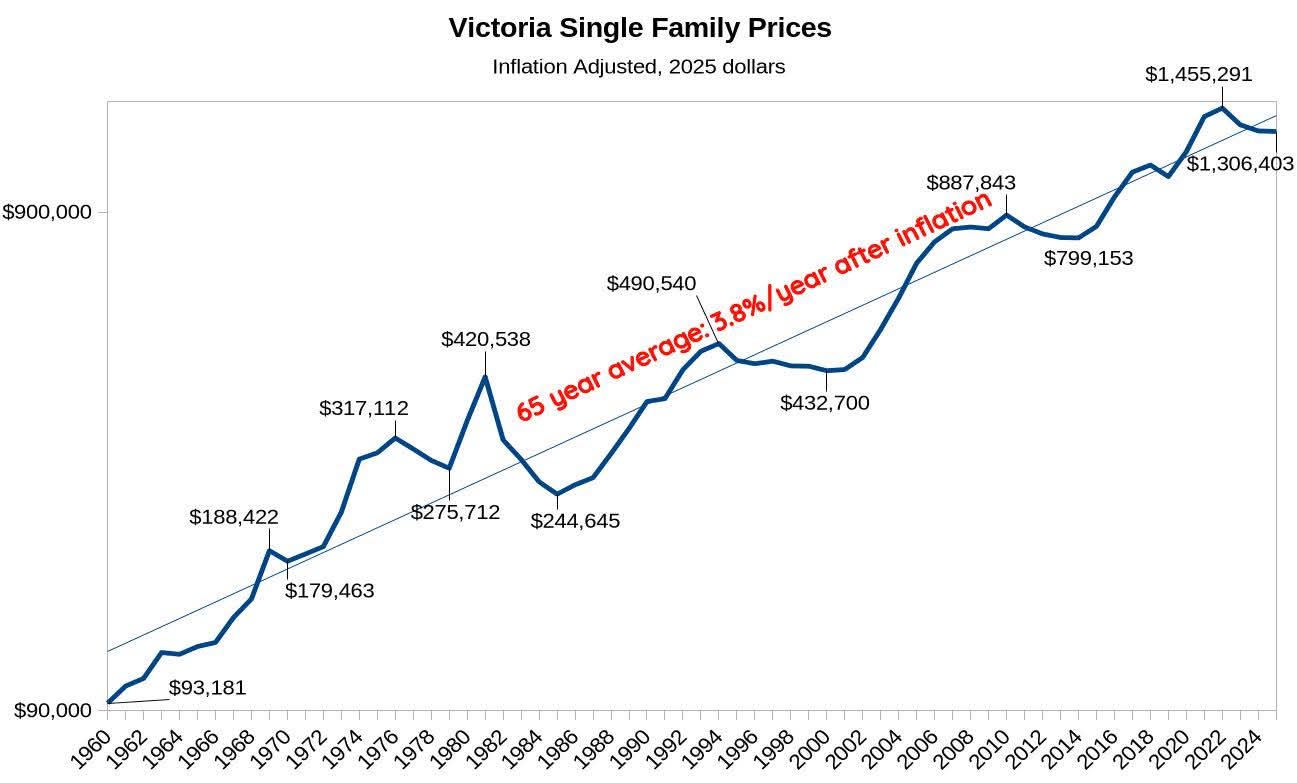
When we look at Victoria BC single-family home price inflation over the last five decades, the long-term trend shows steady growth in nominal prices that outpaces general inflation. While many narratives focus on the recent past, such as COVID, immigration, low interest rates, or specific crises, the evidence shows price inflation has been building over decades. Past performance does not dictate future results, and no single factor exclusively explains this trend. Early Growth: The 1970s and 1980s In the 1970s and early 1980s, Victoria’s housing market began a pattern of rising prices as the region’s economy grew, buoyed by stable government and service sector employment. Through the high interest rates of the early 1980s and the recession of the early 1990s, prices dipped at times but continued a long-term upward trajectory. Stabilization and Expansion: Mid-1990s to Early 2000s From the mid-1990s into the 2000s, demand increased with economic stability, limited developable land on the Peninsula, and relatively modest new supply. Nominal prices continued to rise gradually during this period. The 2008 global financial crisis slowed markets briefly, but there was no prolonged collapse as investors and local buyers still saw Victoria as a desirable place to live. Acceleration During the 2010s Entering the 2010s, prices accelerated markedly. Some attribute rapid price inflation solely to post-COVID dynamics or spikes in immigration. However, while these factors can influence short-term demand, the pattern of rising home values predates them by decades. Low interest rates after the 2008 crisis, provincial and national tax policies, and persistent supply constraints played roles, but none in isolation fully explain the long-term Victoria BC single family home price inflation. The COVID-19 Market Surge During and after the COVID-19 pandemic, many markets, including Victoria’s, saw sharper short-term increases. Still, this represents an amplification of pre-existing trends, not the beginning of them. Factors such as remote work and changing lifestyle preferences likely contributed to near-term demand swings, but research consistently shows that long-term price trends are influenced by multiple factors rather than a single event or policy. Multiple Forces Driving Long-Term Price Growth In reviewing 50 years of data, it is clear that demographics, economics, land supply, local planning policy, and broader macroeconomic conditions all interact. Narratives that claim the market rapidly escalated only after one event, such as COVID, high immigration, low rates, or a past financial crisis, are not fully supported by the evidence. These events influence the market, but long-term price inflation has been ongoing. Understanding Long-Term Housing Market Complexity Understanding Victoria BC single family home price inflation requires acknowledging the complexity of housing markets. While past performance does not dictate future results, long horizons help illustrate that price trends emerge from structural and cyclical influences over time. Lou N., 5-Star Review, via Google “Scott is a knowledgeable, professional, dedicated and thorough expert in his field. Excellent at what he does and we couldn't have found a better realtor to guide us through one of the most important decisions in our lives.” Faber Real Estate Group Royal LePage Coast Capital Realty 📞 250-244-3430 📧[email protected] ℹ️ Scott Faber Personal Real Estate Corporation ℹ️ Cal Faber Personal Real Estate Corporation Vanessa Wood, Zachary Parsons, and Sophie Taylor “Building Lasting Relationships, One Home at a Time.”
Read more